Mastitis
25% of women get mastitis - that's one in every four mothers you know!
70% of these cases occur in the first 4 weeks after your child is born. It's such a full on adjustment period in your life.
 Find out more about the Symptoms of Mastitis |
 Need more information about the Causes of Mastitis? |
 Want to know How To Treat Mastitis Naturally with ALMOST NO PAIN? |
My Story - How I Survived Mastitis
I've had mastitis and I know just how much pain you are in. I found myself sitting in my breastfeeding chair in those first few weeks asking myself -
"Can I keep doing this? How long will it keep being as painful as this?"
It started out with my son not attaching well, in fact the first two weeks I spent with increasing pain during breastfeeding. My labour hadn't left me able to sit comfortably (in fact it took me three weeks to be able to sit up for every breastfeed) so I was trying lying down to feed, but my son wouldn't attach well in this position so I was getting a blister forming on my nipple. I ended up alternating between sitting and lying for each feed.
My happy little world, which was slowly crumbling, abruptly shattered when, on day 12, my blood blister broke during a feed, covering my son's face in blood. I was thinking
"I feel like a failure. I've got less milk and it hurts so much I dread every feed. How can I possibly keep breastfeeding?"
By week 3 I had swollen breasts, which were lumpy, red and sore all the time. My husband had gone back to work and I was dreading each feed. The majority of my day was spent wondering
"How can i get through the first minute of the next breastfeed, let alone the tomorrow?"
Fortunately my supportive husband helped me keep breastfeeding, but the next thing that happened was that I got a blocked milk duct. These were all the things I knew could happen but now I really had an understanding of just how desperately upset I felt during the experience.
I had a lot of extra nipple pain, my breast was extremely tender and I was feeling worse, all the classic symptoms of mastitis.
I was lucky though. I knew several natural mastitis treatments, and how to massage my breasts. Within 24 hours I was better.
The most important thing I've learnt since, and wish I knew at the time, is that a good latch on makes a huge difference to your likelihood of getting mastitis. In hindsight, just knowing this and being more fussy about making sure breastfeeding was comfortable for me would have saved me a lot of pain.
Studies show the biggest causes of mastitis and plugged ducts are:
- Stress!
- Wearing a poorly fitting bra or tight clothing,
- An inefficient feeding technique which only empties a certain portion of the breast,
- An irregular feeding schedule which allows a build up of excess milk in the breast,
- An irregular pumping schedule that makes you create more milk but doesn't necessarily remove it
- Damage to the nipple causing a restriction of flow from one or many of the milk ducts, and potential infection too
- Poor posture during feeding which leads to a decrease of venous and lymphatic drainage of the breast and therefore an increased amount of blood and lymphatic fluid building up pressure within the breast
Most of these problems can be remedied easily with a little information.
Click here for more information to help you understand your mastitis symptoms
Would you like to know the causes of mastitis so you can avoid getting it again?
Back to Breastfeeding Babies Home Page from
Understanding, Avoiding and Treating Mastitis

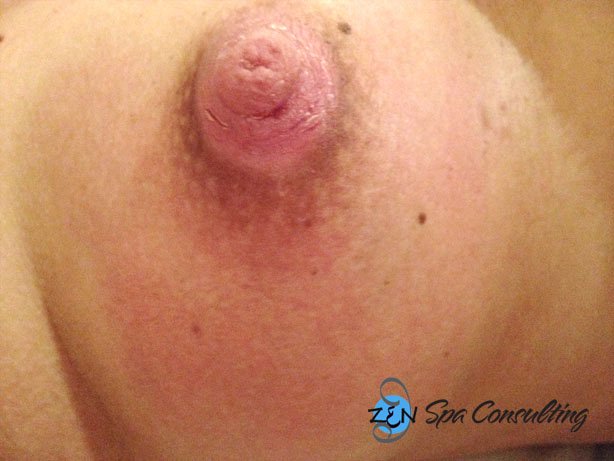
This image shows the redness that you can sometimes see when you get mastitis. It's in most of the breast for this mother. She looks like she's had some damage to the nipple before developing mastitis too.
Image reproduced with kind permission from Zen Spa Consulting

Did I Help You Today?
It costs me money to keep this site running. If I've made your day easier it would be really helpful for me if you could spare a few dollars to help me keep the site running with useful, current information! It's your way of saying
Want to know all the latest breastfeeding advice and news?
Sign up for the Breastfeeding-Babies newsletter below


Want to see how I treated my mastitis WITH ALMOST NO PAIN in just 10 hours?
Click here for more information
New! Comments
What do you think? Any good ideas, suggestions or questions?